The move line on this site, and the commands it borrows
None of the 6 games in this book takes typed commands. The line at the foot of every page does: it is the site’s own way of moving between pages, built on the shorthand of 1980s text adventures.
The 6 one-letter commands
Text adventures share a shorthand, and the best single summary of it is a postcard. Andrew Plotkin wrote “How to Play Interactive Fiction” for the People’s Republic of Interactive Fiction’s room at PAX East in 2010, and Lea Albaugh designed it. The table below follows the card.
| You type | Short for | What the game does |
|---|---|---|
| L | LOOK | Describes the room again. The card: “LOOK around to see what is nearby.” |
| X LAMP | EXAMINE LAMP | Describes 1 thing in more detail. The card’s advice is “When in doubt, examine more.” |
| I | INVENTORY | Lists what you are carrying. |
| N, S, E, W | GO NORTH and so on | Moves you 1 room. NE, NW, SE, SW, UP, DOWN, IN and OUT work the same way. |
| Z | WAIT | Lets 1 turn pass while you do nothing. |
| G | AGAIN | Repeats your last command. |
Verbs for things and verbs for people
The card sorts the rest into what you do to objects and what you say to characters. For objects it calls 10 patterns very common: EXAMINE, TAKE, DROP, OPEN, PUT IN, PUT ON, PUSH, PULL, TURN and FEEL. For a character it gives 5: TALK TO, ASK ABOUT, TELL ABOUT, GIVE TO and SHOW TO.
Grammar stays short. A verb, then a noun, sometimes a second noun after a small word: UNLOCK DOOR WITH KEY. Most parsers ignore capitals, so lower case does just as well.
Commands about the game itself
UNDO takes back 1 move, and the card marks it as handy. SAVE and RESTORE keep and reload your position; the page on saving says where a browser puts it. The card adds that if a game’s opening text mentions ABOUT, INFO or HELP, you should type those first.
When the game says it does not understand
A parser knows the words its author gave it and nothing else. Don Woods’s 1977 version of Colossal Cave Adventure had a vocabulary of 293 words. The usual fixes, in order: pick a simpler verb, use the exact noun the description used, and examine the thing before trying anything clever. If a sentence holds 2 actions, split it into 2 commands.
Where the compass came from
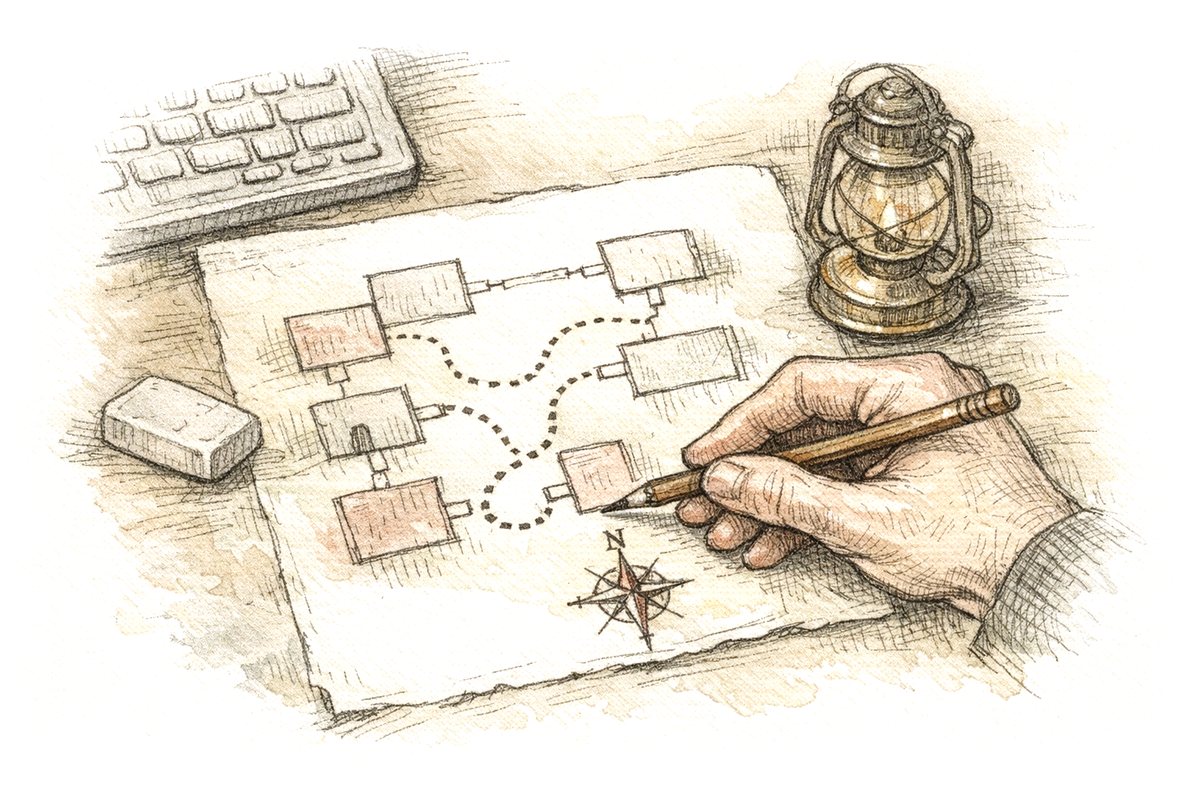
Moving by compass points goes back to Colossal Cave Adventure, which Will Crowther wrote for the PDP-10 in 1975 and 1976. Crowther was a caver, and the game drew on his maps of Mammoth Cave in Kentucky. Woods’s expansion grew it to 140 map locations and 53 objects.
The same game introduced the magic word XYZZY, which moves the player between 2 locations. Wikipedia notes that many later games hide an answer to it as a tribute. The move line on this site answers it too.
How the 6 games are controlled
- There Is No Game
- “Click or tap and drag to interact.” Poki
- Daily Room Escape
- The left mouse button, with on-screen arrows to turn left and right and 12 inventory slots.
- Detective Loupe
- A click to select a clue or a piece of evidence; a right-click to use the magnifying glass. Poki
- TRACE
- “Use the left mouse button to escape.” Desktop only. CrazyGames
- Strange Case
- “Use the left mouse button to interact with objects.” CrazyGames
- Escaping the Prison
- “Mouse click to interact with objects.” The game lists the options; you click 1. Poki
Try the short forms on this page
The move line at the foot of every page on Quest Alder takes a small set of these commands. N, S, E and W follow the exits, L lists them, I shows what the site has stored in your browser and MAP opens the map. Typing the name of a page or of a game goes straight there. It knows about a dozen words and is not a game.